Work for the Best; Plan for the Worst

Half a lifetime ago I enrolled in a Dale Carnegie course to improve my comfort level when speaking to professional groups.  I wasn’t looking for philosophy, but I received a heavy dose of it over the following several weeks.   When I jokingly tried to impart some of this “wisdom” to our teenaged daughters, like, “Act enthusiastic and you’ll be enthusiastic,” they would frequently throw a couch pillow at me.

Seriously though, I found that Dale’s homilies had some merit.  One dwells in the recesses of my mind and appears during troubling times — like right now.  In essence, it councils that a worrier should imagine the worst that could happen in a given situation, make a plan for coping with that outcome and then stop stressing out about it.  I think it is part of Carnegie’s “Stop Worrying and Start Living” advice.

No one has an accurate crystal ball, of course, and typically the terrible things we imagine might happen rarely come to pass.  Yet, we buy insurance for home and autos and keep a fire extinguisher handy in the house just in case.  Still, the pressing question today is – what should we be doing about protecting our future in this period of stress and uncertainty?

Well, I am writing checks to candidates who I believe will provide the best outcome in 2025 and I will vote for those that are on my ballot.  Above all though, I am trying to remain positive and hopeful.  The contest for the presidency is far from over and with President Biden’s decision to exit the race, Trump will be the old guy.  Yes, there is only so much individuals can do to defeat him, but everything we can do will help.

But if our efforts fail and Trump is elected in November – this is my best advice.  Identify those things you can control and carefully manage them to protect yourself and your family.  Think of what you would have done in July 2007 if you had known when the Great Recession would start and what economic problems it would cause.  And pay attention to what experts are predicting if Trump is successful with his agenda in 2025 and beyond. 

A June letter by 16 Nobel Prize-winning economists is worth reading.  They begin by stating that they are “deeply concerned about the risks of a second Trump administration for the U.S. economy.”  They stress that the rule of law, economic and political certainty and stable relationships with other countries are among the most important determinants of economic success.  Their bottom line is that a second Trump term would exacerbate inflation, have a negative impact on the U.S.’s economic standing in the world and a destabilizing effect on the U.S.’s domestic economy.  Oh my!

This letter did not detail the Trump proposals that would cause the problems they fear, but other economists have warned against his plans to deport millions of undocumented immigrants, raise tariffs by 10% across the board and cut taxes. 

A good way to start a plan is with a financial advisor and a review of your investments, particularly bond holdings.  Ask if your portfolio is adequately prepared for the higher inflation and interest rates that economists say could occur.  Remember, even during the Great Depression of the 1930s, many companies did reasonably well, including Coca Cola and Proctor & Gamble.  Food and beverage companies in general prospered, along with those providing other consumer necessities.

A fire proof and water proof safe is nice to have in your home.  One that will hold 1.5 cubic feet of important documents and valuables costs less than $100 and weighs around 30 pounds.  Some can be bolted to a wall to for added security. 

It is advisable to have some cash for an emergency, which can be kept in a home safe.  The amount will depend on what makes you comfortable, perhaps enough to cover most expenses for two weeks.  A global computer glitch caused by software firm CrowdStrike led to widespread outages affecting airlines, banks, and media outlets late last Thursday and Friday morning.  Our society is almost totally dependent on computers and the Internet.  If they fail to work for whatever reason, plastic cards could be temporarily worthless. 

During the Great Recession in 2008 and 2009, right-wing media was spreading such wild conspiracy theories about President Obama that several conservative friends took some rather extreme actions to protect their assets.  Many bought large quantities of gold.  One asked my advice about which gun to buy for his eighty-year-old wife.  It was mindboggling. 

We don’t know what Trump 02 might do, regardless of what he may have said.  He simply lies about everything and a lot will depend on which party controls Congress in 2025.  Things might not be as bad as we suspect – or – they could be worse.  But for sure, do not believe anyone who tells you, “Don’t worry, everything will be just fine.”  

I’m not suggesting that anyone take extreme measures.  But I am confident that those who carefully plan for the worst will feel more secure and be better prepared to cope with whatever happens in November.

Posted in Uncategorized | 1 Comment

Human Capital – Our Most Valuable Infrastructure

Ask anyone about infrastructure and they will probably mention roads and bridges.  There is a broader definition, however, that describes an asset as infrastructure according to its contribution to the economy.  I believe this includes human capital – the knowledge, skills and experience of American workers. 

Congress finally approved some concrete and steel projects and President Biden eagerly signed his Bipartisan Infrastructure Law in November 2021.  Although much more investment like this is needed, this legislation is critically important.  It provides $1.2 trillion in funding to improve America’s roads, bridges, rail systems, airports and ports.  No question, but for the federal government, U.S. infrastructure improvements would be woefully underfunded.  Most states simply can’t afford to pay for them.

Still, I believe most Americans agree that these improvements were an appropriate use of their tax dollars and so should the leaders of all companies that do business in the U.S.  They will make life better for all U.S. residents and help businesses be more efficient and profitable.  Even some of the 200 House Republicans that voted against this law attempted to take credit for the projects it funded in their districts. 

I keep wondering though, why was it so difficult to get this quite modest but greatly needed bill passed and why has it been such a monumental task for decades to enact legislation to improve America’s human infrastructure?  And why isn’t our military a great example of the value for these investments.

Funding the Department of Defense is always a high priority for Congress, so it probably has the best maintained infrastructure the nation can provide.  This includes the Pentagon’s schools for 66,000 children of military families, which may be the nation’s best, according to a 2023 New York Times article.  It explains why: They are “well-funded, socioeconomically and racially integrated, and have a centralized structure that is not subject to the whims of school boards or mayors.”  As evidence it cites the fact that these schools outscored every other jurisdiction in the nation in math and reading in 2022.

In addition, these students are probably better fed than millions of public-school children. Plus, at least one parent is working and the military provides the family with housing and medical care.  Basic human needs like these are crucial for children to learn and develop.   

The National School Lunch Program (NSLP), which was enacted in 1946, recognized this fact.  It provides free lunches for students from households with incomes at or below 130% of the federal poverty level and reduced priced lunches for students from households earning between 130% and 185% of the poverty level.  Over 60% (30+ million) of all public-school children received these benefits in fiscal year 2022, according to USAFacts, a nonpartisan organization. 

If you think these statistics indicate that many students are poorly fed when not in school, you are correct.  

Still, earlier this year, 15 GOP governors refused to take advantage of a new, federal bipartisan summer program that would provide states with $2.5 billion in funding for healthier food options that will help 21 million low-income children when school isn’t in session.  Among these are Texas and Florida, the second and third most populous states.  Iowa governor Kim Reynolds cited an epidemic of childhood obesity as the reason her state would not participate, which I think is beyond ludicrous.

I believe red state resistance to federal programs like this is a significant reason why children are more likely to live in poverty in America than in most of our peer countries.  In fact, data analyzed by the Organization for Economic Co-operation and Development (OECD) for 2022 shows that American children under 18 are almost twice as likely to grow up in poverty as those in Germany, more than twice as likely as children in Canada and over three times more likely than children in Norway.  Its analysis also reveals that the U.S has child poverty levels like Chile and Mexico, which should embarrass our Congress.

To me, it makes perfect sense to lift people out of poverty, and strong evidence that doing so could reduce or improve the effectiveness of federal and state spending in the long term is provided by the following analyses.

An April 2020 study by the National Bureau of Economic Research, a nonpartisan organization, found that children who received food stamps under the Supplemental Nutrition Assistance Program (SNAP) were more likely in later life to be healthier, better educated, employed, earn higher incomes, be more self-sufficient and less likely to be incarcerated.   These benefits not only enhance the quality of life for these individuals, they reduce the burden of society (government) to care for them.  

A July 2023 report by the Congressional Budget Office states that Medicaid enrollment during childhood has been shown to increase earnings in adulthood.  Its research estimates that the long-term fiscal effects of Medicaid spending on children could offset half or more of the program’s initial outlays. 

All my research on federal budgets and programs leads me to conclude that shrinking the federal government and underfunding investments in the social safety net and America’s human infrastructure to offset the cost of tax cuts for corporations and the wealthy are shortsighted, disastrous policies.  They will be detrimental to the future of all Americans and to the U.S. economy, which will cause even more voters to believe empty populist promises and question capitalism and democracy.

Posted in Uncategorized | 3 Comments

Why the United States Is a Powerful Nation

Some politicians act as if the military makes the U.S. the most powerful country in the world, but that is just part of America’s strength.  China reportedly has around 700,000 more active-duty soldiers and Russia’s military is about the same size as ours.  There are other qualities, however, that put this nation in a position of power that I believe are much more important – and I’ll get to that. 

But first, let’s look back to the end of World War II when the United States had become the world’s only true superpower.  Many European and Asian nations were in ruins due to the war, with their cities and manufacturing capabilities destroyed, particularly the defeated nations of Germany and Japan.  China was still a backward third-world country in 1945, struggling with a civil war.  The Soviet Union would become a lesser superpower in time, primarily because of its natural resources, its military and its nuclear weapons.    

Other than the tragic loss of over 400,000 lives, the major negative effect the war had on America was the massive deficit spending required to fund it.  But on the plus side, the U.S. manufacturing capability was in great shape, as was its infrastructure, much of which had been enhanced by President Franklin Roosevelt’s pre-war New Deal.  This nation was enjoying a stable government (which controlled most of the world’s gold), a productive economy and a strong currency, the all-mighty U.S. dollar.  Even before the war ended, these factors led to the critically important Bretton Woods Agreement in July 1944, named for the small resort town in New Hampshire where it was signed by 44 nations.

This agreement formed the structure of a new financial system for the global economy.  It also established the U.S. dollar as the “international reserve currency,” a position that it holds to this day.  My guess is that most members of Congress are not aware of the Bretton Woods Agreement, nor do I believe they understand all the benefits of our dollar’s status.

Why is the U.S. dollar so important?  Well, other countries treat it and dollar denominated securities (U.S. Treasury bonds, for example) almost like gold.   In fact, central banks in nations around the world held around 59% of their reserves (savings) in U.S. dollars or U.S. government debt instruments in 2022, according to the International Monetary Fund. 

High demand for the dollar enables the United States to borrow at much lower rates than other countries and more easily finance deficit spending.  American companies also have an advantage because they can conduct business in dollars without having to pay the costs of converting into other currencies.

Ever wonder why our government can impose sanctions on other nations, like Iran and Russia?  There are numerous ways, but one is because the Bretton Woods Agreement effectively gave the U.S. power over the international financial system.  The U.S. Treasury Department regulates access to and use of the U.S. dollar, which is the currency used for most international transactions, like crude oil, for example.  That is one reason why Russia’s Vladimir Putin and China’s President Xi, among other authoritarian regimes, want to end the global reliance on dollars.  And even some U.S. allies complain about the dollar’s dominant status.

Oh, but whenever there is a global economic crisis or troubling times, frightened foreign investors are eager to invest in the U.S., buying dollars and U.S. Treasuries.  Like sailors in a storm, they rush to the safest harbor.  Even in good times, foreigners own around 40% of U.S. corporate stocks, according to the Tax Policy Center and Federal Reserve data. 

A May article by the nonpartisan Budget Lab at Yale University summarizes why U.S. assets are so attractive.  Of course, it emphasizes the importance of the U.S. credit rating, its dollar, the nation’s large, highly productive economy and the safety and liquidity of U.S. Treasury securities.  But I believe the following two criteria also cited in this article correctly identify what truly forms the heart and soul of U.S. power, the U.S. Constitution and the system of government it established:

Independent institutions:

  • The U.S. Federal Reserve (central bank) that underpins the U.S. economy and the financial system is credible and politically independent.
  • The U.S. Treasury Department is staffed by professional career civil servants and finance savvy political appointees.

Legal & political stability:

  • The American legal system is relatively fair and equitable (the rule of law prevails). 
  • The U.S. has conducted over two centuries of mostly unblemished, regular elections. 
  • The professional U.S. bureaucracy produces credible and highly respected data, particularly economic.
  • The civilian controlled military does not get directly involved in American politics.

I believe the foregoing clarifies that democracy is what makes our nation powerful and that the U.S. dollar’s strength and status depend on it.  I am also confident that these criteria have allowed American capitalism to function as it has for over two centuries.

What I fear, however, is that many voters – including some friends who don’t read my posts – lack a clear understanding of what makes America great and what is at stake in November’s election.  So, in hopes that what I write will reach some of them, my blogs this summer will focus on information that I believe voters should consider before November’s election.  Hopefully, more of them will come to understand that nothing is more important than preserving U.S. democracy.

Posted in Uncategorized | 3 Comments

Federal Budgets: What You Don’t Know Can Hurt You

Federal budgeting may be Congress’ most important duty.  It determines how much revenue the government collects and how tax dollars are disbursed, the results of which significantly touch the life of every American.  Yet, disingenuous politicians get away with egregious claims about the budget because voters are uninformed or misinformed about how spending decisions by Congress can affect them and their families. 

The numbers alone are mind boggling, dollars and agencies and programs.  Oh my!  No wonder voters are confused, and discouraged from even attempting to understand how the process works. 

Well, since Congress is currently working on the fiscal year 2025 budget, how about we take a little time to consider some budget facts and realities.

Let’s start with the federal budget’s three major categories:

  • Discretionary spending – Includes the Department of Defense, congressional operations, the federal courts, and the other federal agencies, as specified by 12 yearly appropriation bills.  This legislation allocated only 27% of total government outlays in FY 2024.  In the budget summary, this spending appears as defense, and nondefense. 
  • Mandatory spending – Includes Social Security, Medicare, Medicaid and numerous other programs.  It is not subject to yearly budgeting, so this spending continues year after year and is limited only by formulas that Congress has established in various laws, like the Social Security Act.  It was almost 60% of the total FY 2024 budget. 
  • Interest – Service on the national debt was a little over 13% of the total FY 2024 budget.

Congress is required to pass the 12 appropriation bills each year prior to the start of the next fiscal year that begins October 1.  The final six bills for FY 2024, however, were finally completed last month, almost six months late.  In fact, the last time Congress passed all these bills on time was almost 30 years ago.

The largest components of mandatory spending are, in size order, Social Security, Medicare and Medicaid, which total almost 56% of the FY 2024 budget, not including interest.  The $1 trillion cost of other programs in this category – food stamps (SNAP), federal/military retirement benefits, veterans’ benefits and numerous “other” programs – is also quite significant. 

Interest on the debt is equally large, projected to be almost $1 trillion for FY 2025, which will exceed, individually, both defense and nondefense spending that year.  

It is often said, and I agree, that the U.S. government is primarily a huge insurance company with a large military.  Here are just a few examples why:  When a disaster strikes in the United States, which is quite frequent, both blue and red state governors invariable call on the president for federal relief.  Medicare covers over 63 million seniors; Medicaid provides health insurance for millions of other Americans and so does the Affordable Care Act (Obamacare). 

Several mandatory federal programs, like Medicaid, are “means tested,” making them mainly available to low-income Americans.  They include those that provide food stamps, and tax credits for earned income and children.  Republicans often erroneously blame “welfare” programs for the deficits.

Since 2000, however, the most significant causes of large federal deficits have been wars in Iraq and Afghanistan, the Great Recession, and the Bush and Trump administrations’ tax cuts for corporations and the wealthy.  A 2023 study by the Center for American Progress found that these tax cuts added $10 trillion to the federal debt as of FY 2022, accounting for a 57% increase of the debt as a percentage of gross domestic product (GDP). The debt-to-GDP ratio is closely monitored by economists and policymakers, as a higher ratio can signal economic instability.

Still, prior to the covid pandemic and the Russian attack on Ukraine, I was not nearly as worried about yearly budget deficits and the national debt as I am now – and here is why:

  • The coronavirus pandemic ballooned the deficits, devastated the economy and killed over a million Americans.  Another pandemic is highly likely; preparing for it and handling it could cost trillions of dollars.
  • Russian President Vladimir Putin has crossed the Rubicon by attacking Ukraine and threatening Western Europe and he is allied with Iran, North Korea and China.  Countering this aggressive, authoritarian alliance will cost more trillions.
  • Medicare costs are soaring as the population ages and climate change is an existential threat to the U.S. that must be addressed in future budgets.

Recent Congressional Budget Office baseline budget projections show that the expected deficit in FY 2025 will be almost $1.8 trillion, which will exceed the entire discretionary budget that funds government operations and defense.

Clueless presidential candidate Trump and congressional Republicans, however, are planning additional trillion-dollar tax cuts if given the chance and House Republicans have proposed massive reductions in Medicaid programs, which are critical to saving lives during a pandemic. 

Equally concerning is the ultra-conservative Project 2025 report.  It advocates replacing thousands of federal employees with inexperienced ultra-conservatives who are loyal to Trump, the autocrat-loving, climate change denier who bungled the critical early responses to the pandemic in 2020.

I believe that Trump and most Republicans in Congress are either ignorant of these budget realities or simply don’t care about them.  They are adamant that taxes can never be increased, and that spending must be slashed to reduce deficits and balance the budget. 

Well informed voters should realize that these Republican objectives can only be accomplished with massive cuts to Social Security, Medicare and Medicaid.

PS – Readers who are interested in diving deeper into the workings of the federal government and the budget process should click on the “Helpful Info” tab under the picture on the homepage of my blog site.

Posted in Uncategorized | 1 Comment

Being Totally Candid About the 2024 Election

Let’s face it, most of the Republican members of Congress are either authoritarians, stupid, radical right or cowards, with the majority falling into this latter category.  Voters can no longer trust them to do the right thing for the nation or the people.  They do whatever former president Trump tells them to do because they fear him.  Is this my opinion?  Damn right!  But what Republicans say and do every day confirms it in spades.

Many of the more rational House Republicans have either lost primary elections to obstructionists, or left Congress.  Now, second term Rep. Margorie Taylor Greene (R-Ga.), who is beyond radical, wields great power in that chamber, along with others of her ilk, including leaders of the hard-right House Freedom Caucus and the 160+ member ultra-conservative Republican Study Committee.

The Senate is almost as bad; Utah’s Mitt Romney won’t return in 2025 and anti-democracy Sen. J. D. Vance (Ohio) replaced moderate Rob Portman in 2023.  He joined, among other election deniers, Sen. Ted (crazy) Cruz (Texas) and Sen. Josh Hawley (MO), who was video-taped supporting the Capitol attackers with a raised fist. 

Trump now has control of the Republican National Committee (RNC), installing his right-wing daughter-in-law as co-chair.  The GOP as we have known it during our lifetimes no longer exists; it is totally the party of Trump.  Consequently, even if he is convicted of one or more criminal charges prior to the Republican convention, Trump will almost certainly be the party’s nominee. 

What brought the GOP to this sad state?  Well, I totally agree with political blogger Charles P. Pierce who wrote, and I am paraphrasing, that it results from thoughtless gerrymandering, massive amounts of unregulated money that prevented the RNC from maintaining discipline over nominees and the steady deterioration of conservatism since Ronald Reagan’s philosophy began influencing the party in the late 1970’s.

Of course, congressional Democrats certainly aren’t perfect and their caucus has some radicals too, but as a whole, they support the rule of law and the Constitution’s democratic principles.  In my opinion, their legislation is primarily designed to improve the health, safety and welfare of Americans.  Yes, they may propose too much government and too much spending, but I believe it is all within the framework of our constitutional democracy and intended to benefit the entire population.  What’s so bad about that?

My greatest concern today, however, is Trump.  He is facing civil and criminal charges that could destroy his businesses and put him behind bars for the rest of his life.  I am virtually certain that he will be convicted of numerous crimes if he goes to trial in either federal case or the Georgia case.  He knows that too.  That’s why he is frantically trying everything possible to avoid a trail, including the one in Manhattan later this month, which could also convict him of several crimes.

Some legal experts, like Andrew Weissmann and Neal Katyal, seem to basically agree with my assessment that Trump’s best chance of avoiding criminal penalties is by winning in November and attempting to stay in office after 2028.  But I haven’t heard them fully articulate what they believe will likely happen if he loses. 

Trump is literally fighting for his freedom and his fortune.  And I have no doubt that he will do anything to avoid losing either one.  The rule of law, the Constitution and democracy mean absolutely nothing to him.  Think about it, if he doesn’t win the election, what the hell does he have to lose by attempting to incite nationwide violence or even a civil war?  

Trump praises the January 6 insurrectionists as “patriots,” many of whom he promises to pardon if he is elected.  He is legitimatizing their effort to violently reverse the outcome of a valid election.  He is also signaling to his supporters that they should get ready for a second attempt and that he will pardon them if they succeed.  It’s exactly like his 2020 debate statement about the far-right Proud Boys extremist group, “Stand back and stand by.”

The House January 6 Committee recommended that the Biden administration take extraordinary measures to ensure a fair election in 2024 and a secure transition period to the next administration.  They also advised that President Biden designate the joint session of Congress that will certify the election next January as a “National Special Security Event,” just like the inauguration and the State of the Union address.  This will mandate elaborate planning and expanded security measures and I believe the president will follow through.

I have not expressed my darkest concerns in recent posts; why add to all the depressing political news, I thought.  But no good purpose is served by clouding reality any longer: Donald Trump is like a cornered, wounded carnivore who will attempt to destroy anything and anybody that blocks his escape from accountability.  Truth is, even if he loses in a close election, our nation will still likely face a deeply troubling, possibly horrific, situation.

Polls show that most voters support democracy, the Constitution, and our democratic institutions.  That’s encouraging.  But naively hoping that everything will turn out okay – or not voting because neither candidate is appealing – could spell disaster this year.   

Biden’s poll numbers are improving and I don’t believe Trump will win come November.  But all democracy-loving Americans should get actively engaged in the process to ensure he is soundly defeated.

Posted in Uncategorized | 4 Comments

Aging America Depends on Immigrants to Prosper

New Citizens By Susana Raab

A speech by President Ronald Reagan on January 19, 1989, absolutely “nailed” the importance of immigrants to the United States: “Thanks to each wave of new arrivals to this land of opportunity, we’re a nation forever young, forever bursting with energy and new ideas, and always on the cutting edge, always leading the world to the next frontier. This quality is vital to our future as a nation. If we ever closed the door to new Americans, our leadership in the world would soon be lost.” 

Earlier, Reagan had signed the Immigration Reform and Control Act of 1986 that legalized most of the roughly 3 million undocumented immigrants who had arrived prior to 1982.

Whatever you might think of him, Reagan was a bona fide conservative Republican, lightyears apart from the anti-immigration, populist RINOs (Republicans In Name Only) like former president Donald Trump and many of his supporters. And what he said 35 years ago is just as valid today as it was then – even more so. 

Yes, immigration and immigrants must be carefully controlled and managed.  More on that later.  But first, please bear with me for some helpful facts and statistics.

Estimates vary, but there may be close to 50 million foreign-born residents in the country today, which would be approximately 15% of the population.  In fact, the United States was home to more international migrants than any other country, according to the UN Population Division’s mid-2020 data, exceeding the combined totals of the next four countries – Germany, Saudi Arabia, Russia, and the United Kingdom. 

U.N. World Population Prospects 2022 estimates that low birthrates and other factors will cause working-age populations (ages 15 to 65) of Europe, Brazil, China, Chile, Japan and Russia, among others, to shrink between now and 2050.  According to a February New York Times article, this shrinkage “could have extremely negative consequences for those societies.”  During this same period though, the number of working age individuals in the U.S. is projected to increase by 8%, mainly due to immigration.

Some countries have attempted to boost birthrates with tax breaks and cash bonuses, but the results have been marginal at best. The fact is, once birthrates fall it is extremely hard to get them back up again.  Fortunately, the United States had a modest increase in births between the 1970s and 2016, according to Pew Research, but it was due entirely to births by immigrant mothers.  I suspect that trend is continuing.

The NYT article also highlighted another expected result of decreasing population: As young and working-age people leave an area to find better job opportunities, its population ages and its economy becomes depressed.  Consequently, transportation services decline, schools close because there are fewer children and hospitals shut down.  Psychologically, those who remain feel neglected and undervalued by the political elite, which makes them particularly receptive to far-right politics.  Does that “spot on” explain what is happening in rural America, or what?

Well, evidence of this rural red phenomenon is clear. Trump won 2,569 U.S. counties in the 2020 election and President Biden won just 515, according to the Brookings Institution.  But this is the clincher, counties that voted Democratic comprise around 71% of America’s economic activity, vs. 29% that voted Republican.  Right-wing politicians pray on grievances of voters in economically depressed areas.  The facts, however, show that their policies of restricting immigrants and immigration, will only exacerbate the problems.

I don’t believe there is any reasonable doubt that immigrants are a boon to the U.S. economy and that is confirmed by officials who have their fingers on its pulse. 

Director Phillip Swagel wrote that the Congressional Budget Office’s February economic and budget forecasts have factored in a previously unexpected surge in immigration that began in 2022, which the agency assumes will persist for several years.  As a result, he advised, “we estimate that, from 2023 to 2034, GDP will be greater by about $7 trillion and revenues will be greater by about $1 trillion than they would have been otherwise.”  Yes!  More immigrants, more federal revenues.

Federal Reserve Chair Jerome H. Powell also cited immigration as being a long-term benefit to the U.S. economy during a recent appearance on CBS’s “60 Minutes.”

The Census Bureau is projecting a rapidly aging U.S. population, where people over 64 will outnumber children under 18 by 2029, according to a November 2023 Axios article. Its projections also show that with low immigration the population will soon begin decreasing, going from around 335 million today to an estimated 319 million in 2080; while high immigration will increase it to 435 million. How can the U.S. maintain strong economic growth and support safety net programs without population growth?

It’s imperative, however, that the flow of asylum seekers and other undocumented immigrants coming across the southern border and elsewhere is controlled.  Numerous Republicans spuriously claim that Biden can solve the border problems with executive orders.  Oh, but he can’t unilaterally increase appropriations to hire more border patrol agents or immigration court judges nor otherwise increase funding for immigration administration.  That requires action by Congress, which has considered five major immigration reform bills since 2006 and failed to pass even one.

Trump’s opposition killed a tough, bipartisan border bill just last month.  He wants immigration to be a continuing hot campaign issue, while promising to deport millions of undocumented immigrants if he is elected.  How wrongheaded is that?

Posted in Uncategorized | 3 Comments

A Letter to U.S. Supreme Court Justices

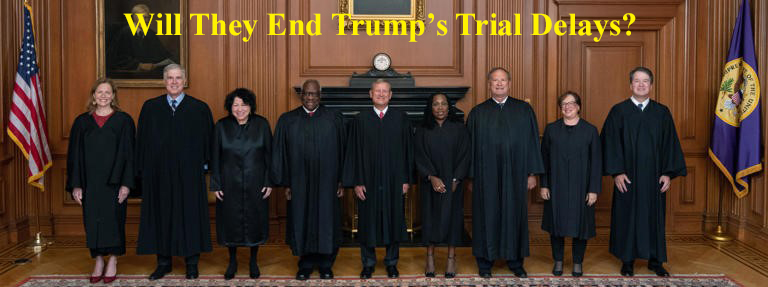
The United States Supreme Court

Today I’m sharing the text of my February 12, one-page letter to all nine members of the Court, followed by my comments on the concerns it expresses. 

The letter:

In my opinion, the originalists on this Court are deciding 21st Century issues by applying 18th Century thinking, when men held slaves, women could not vote and slave states wanted to maintain this abominable legal status.

I believe an originalist (textualist) should interpret the 2nd Amendment the way it reads and hold that slave states designed it to ensure that their militias couldn’t be disarmed by the federal government.

In my opinion, the Court’s holdings in Heller on guns, Citizens United on campaign financing and Shelby County on voting rights were some of the most democracy damaging any Court has ever made.  

As a result of these decisions, thousands of Americans are dying due to minimal gun controls, special interest money is corrupting our politics and anti-democratic, voter suppressing restrictions are being imposed on millions of our citizens by Republican-controlled states. 

Due to former president Trump’s Big Lie, election workers are afraid to serve; millions of Americans no longer trust elections; many government officials and judges need 24/7 personal security protection; there is open talk of civil war; and the rule of law and our democracy are both on the line in the 2024 election.  Do not just blame politics; the Court shares the fault for this horrific state of affairs.

As a citizen and a lawyer, I feel helpless and appalled watching Donald Trump bullying this nation toward an autocracy, aided by a radicalized Republican Party.  And if he dismantles our democracy during a second term, which he has threaten to do if he is elected, I believe this Supreme Court will be reviled as one of the major reasons for its demise. 

The Court should have found a way to rule that the 2020 election was fairly won by Joe Biden.  It would have been easy for this Court to do so.  That may have prevented the insurrection on January 6, 2021, and settled the bogus election fraud issue that is quite literally tearing this nation apart. 

I have absolutely no doubt that a President Trump will treat Court decisions as advisory opinions and politics will override the Constitution and replace the rule of law.  And you may be left wondering if you and the Court could have prevented this.  Well, this year it is not too late for the Court to do that.

My comments about the letter:

All six conservative justices are originalists or textualists who attempt to interpret the Constitution’s wording as it was understood when it was written in the 1780s or when later amended. I believe they apply their originalist theory selectively, as it suits their ideology. 

For example, in the Heller case they held that the right to gun ownership is not limited to service in a militia, despite the 2nd Amendment’s prefatory clause that states, “A well-regulated Militia being necessary to the security of a free state.”  Why would the Founders have emphasized militias if they intended that all Americans had the right to bear arms regardless? 

Citizens United held that corporations have free speech protections under the 1st Amendment and that money is speech, thereby invalidating campaign finance laws.  Consequently, our political system is corrupted by special interests and foreigners. 

The Shelby County case gutted part of the Voting Rights Act, which required that voting law changes by certain states be preapproved by the Justice Department. Republican-controlled states immediately enacted strict voting laws, many designed to discourage Democrat-supporting minorities from voting.

How can Trump dismantle democracy?  Project 2025, which I covered in a previous blog post, is the far-right conservatives’ plan to totally control the federal government by replacing nonpartisan civil servants with Trump loyalists and politicizing the U.S. Justice Department.  With Trump in command of the military, the intelligence services and the Justice Department, the rule of law will be as he dictates and he will use the legal system to shield his operatives and attack his opponents.  Effectively, American democracy will be history.

The conservative justices totally control the Court’s schedule; they could have taken a case involving 2020 election fraud and decided that there was none.  They cannot, however, keep Trump from ignoring their decisions if he is president.  Why?  Because the Supreme Court has no way to enforce its opinions even though they are the law of the land to be followed by the president and all U.S. courts. 

President Andrew Jackson, who Trump reveres, defied the Supreme Court’s ruling in Worcester v. Georgia (1832), which held that Georgia could not enforce its laws on Cherokee lands.  The state did it anyway.  Jackson allegedly challenged the Court: “[Chief Justice] John Marshall has made his decision; now let him enforce it.”  No doubt, Trump would follow his example.

Make no mistake, the final point of my letter – that Trump will ignore Supreme Court decisions – is not mere conjecture.  Trump has demonstrated his disdain for the rule of law in many ways, defying subpoenas, demonizing numerous judges and suggesting suspending the Constitution.

Cowardly Senate Republicans refused two impeachment opportunities to stop the former president from hijacking their party.  Now the question is, will the Supreme Court put an end to Trump’s incessant delaying tactics and finally allow the judicial system to hold him accountable for his crimes?

PS: Sharing your concerns with your congressional representatives this year is crucial.

Posted in Uncategorized | 6 Comments

Revive the American Dream to Restore the Middleclass

My high school educated father worked at a small chicken hatchery in rural Iowa in 1948, where he earned what would be around $50,000 per year in today’s dollars.  He and my homemaker mom provided well for our family of five on his income and that year bought their first modest home for around $5,000.  Two years later, they purchased their first new car, a basic 1950 Ford for around $1,500.  We were solid middleclass in this area.

My parents lived the “American Dream” by persevering through the Great Depression with three kids, working hard and playing by the rules.  So, they achieved a comfortable life for our family and, in time, had a secure retirement.  A significant part of their success was owning a home.

Sadly, the middleclass has shrunk and many Americans now believe that working hard is no longer the key to success.  Frequently, they blame the political establishment – and even democracy. 

To make the American Dream a reality again, however, we must first understand why it faded.

Simply stated, the cost of achieving the fruits of the dream – owning a home, educating children, living comfortably and enjoying a secure retirement – has increased much faster since the 1970s than the salaries and wages of most working-class Americans.  Why?  Let’s dive deeper.

The U.S. median household income, where half earn more and half earn less, is a good indicator of financial wellbeing.   According to the Census Bureau, the median was $65,750 in 1984, when inflation adjusted to 2023 dollars.  The median household income in 2023 was $74,580, an increase of only 13% in real (inflation adjusted) income over the past four decades. 

The average price of a house, however, has risen over 500 percent since 1983, according to the St. Louis Federal Reserve.  The inflation adjusted cost of a four-year, college degree between 1980 and 1984 – including tuition, fees, room and board – was around $41,000 according to the National Center for Education Statistics.  That cost had almost tripled by 2020.  These statistics alone speak volumes about the declining prospects of working-class Americans.

Okay, why haven’t their incomes increased more?  Well, one reason is the decline in union membership.

In 1983, there were 17.7 million union members, according to the Bureau of Labor Statistics, a little over 20% of the salary and wage work force.  Today, there are 14.4 million union members, only 10% of that workforce.  The median weekly earnings of union members are 16% higher than non-union, also according to the BLS.  And union wages tend to push non-union wages higher too, as employers compete for workers.

State right to work laws are frequently blamed for declining union membership.  They dictate that workers cannot be compelled to become union members nor pay union dues if they work in a unionized workplace.  Twenty-seven – primarily Republican-controlled – states had enacted these laws by 2022, mostly in the South and West.  So, it’s not surprising that the median wage in these states is much lower than in states without these anti-union laws.

Minimum wage laws have also helped raise the pay of many working-class Americans, but not in all states.  President Franklin Roosevelt’s Fair Labor Standards Act established the federal minimum wage at 25 cents per hour in 1938 but it was not indexed to inflation.  Congress last increased it to $7.25 in 2009 and 20, mostly Republican-controlled, states have adopted this woefully inadequate wage.

Fortunately, progressive states and cities have raised the minimum wage significantly for their citizens, some higher than $15 per hour, and 13 states have indexed their wage to inflation.  In fact, in January, the minimum wage increased in 22 states.  And like union negotiated wages, these increases tend to boost wages for all hourly workers.  Still, most minimum wage laws only help workers survive.

Some economists believe that offshoring manufacturing jobs since the 1970s caused the stagnation in workers’ wages.  Certainly, that played a role but a 2021 research report by economists at the National Bureau of Economic Research indicates that automation for the past four decades was the real driver in depressing U.S. wages. 

A graph they produced shows that real (inflation adjusted) earnings of men without a high-school degree were 15% lower in 2017 than they were in 1980.  High school graduates had done a little better and so had those with some college but their real earnings were also less than in 1980.  Those with a bachelor’s degree had substantial real earnings growth but still much less than those with a graduate degree.  Women, on the other hand, did much better than men at all educational levels.

Other factors have also dramatically affected the American Dream: The cost of health care has skyrocketed over the past four decades; many corporations no longer fund defined benefit pension plans; and the S&P 500 stock market index has increased 3,057% since 1984, which has overwhelmingly benefited only the top 10% of wealthy Americans.

I believe frustrated Americans who blame the political establishment for their plight, paved the way for outsider Donald Trump’s 2016 election that ignited the populist fervor called Trumpism.  But here is the amazing irony, Trump and the GOP seem to be receiving lots of support from American voters whose grievances are primarily the result of Republican’s trickle-down ideology.

Well, I believe the American Dream can be significantly revived simply by voting most of them out of office.

Posted in Uncategorized | 4 Comments

Accentuating the Positive Over the Negative

*Seasonally adjusted earnings for all employees on nonfarm payrolls. Source: Bureau of Labor Statistics. From: Statistica.

At the dawn of this election year, it seems likely that the results of the November election will depend significantly on what happens in the economy between now and October.  Today, Americans may be focusing more on the bad news and ignoring or unaware of all the good news.  In fact, there are more positive indicators today than I can include in this blog.  Hiding in the dark forest of recent scary articles, however, was one that caught my attention: Americans are too pessimistic about the future.  It recalled an old song, “I’m a lonely little petunia in an onion patch.”

This article by Washington Post foreign affairs columnist Fareed Zakaria covers some of the same positive economic news that I included in my December 16 blog, but from a more international perspective.  For example, he reported that the International Monetary Fund’s expected 2023 U.S. growth rate of 2.1% is substantially better than anticipated for Canada, Germany, Britain and other developed Western countries.

But a couple of other points Mr. Zakaria briefly mentioned are also very significant.  One was that the U.S. is the world’s largest producer of oil and gas.  This makes laughable the MAGA leader’s plans as a “dictator” on day one of his presidency to “drill, drill, drill.”  According to another WAPO article on December 31, the U.S. is currently “producing more oil that any country ever has,” which is keeping the price of gasoline reasonable and moderating inflation.

Another emphasized America’s positive demographics for the future.  Zakaria states that legal immigration increases U.S. population by around one million persons each year, while those in Japan, and other developed nations are slowing diminishing.  This adds to the number of U.S. workers, which is critical to support a growing economy.  China’s is shrinking to the point that the government is encouraging women to quit working and have more babies.  Truth is, immigrants are now and always have been a huge positive for our nation and will continue to be in the future.

Zakaria also referred to the latest Pew Research Center survey on how 24 countries view the United States versus China.  It revealed that 22 of them believe the U.S. contributes more favorably to peace and stability around the world, particularly by huge margins in Japan, South Korea and India.  That attitude will help America maintain its global leadership and bolster democracy.

There were numerous other articles that contained some really good news too, including one about decreasing U.S. crime rates.  Republicans will use misinformation to hype rampant criminal violence in coming months.  Yet, almost all criminal activity significantly decreased in 2023, except auto theft, according to an article by Jeff Asher, a freelance writer who studies the FBI’s Uniform Crime Reports.  He refers to last year’s third quarter FBI reports – the most recent available – which show that violent crime in the U.S. was down by 8.2% in the previous nine months.  Asher’s research also shows that murder is down a whopping 12.7 percent as of last November, having declined in 73 percent of over 175 cities where data is available. 

There is a very promising article by Axios this month on the state of manufacturing in the U.S.  It presents a graph of Census Bureau data compiled by the Federal Reserve that shows manufacturing-related construction spending increased to a stellar $210 billion annual rate last November, which is over three times the average rate in the previous decade.  This piece by Emily Peck credits President Biden’s Chips Act and Bipartisan Infrastructure law for the surge in overall construction spending.  When operating, these factories will provide good paying jobs for thousands of Americans, particularly in red states where many of them are located. 

Another January article from Axios reports that the average monthly hiring by construction firms last year was 16,000, according to the U.S. Labor Department, far surpassing the 11,000 per month they added pre-pandemic in 2019.  Plus, there were nearly a half million unfilled construction jobs last November, near the highest since 2000, when record keeping began.  And 216,000 total jobs were added in December.

True, stubborn inflation has been a drag on consumer optimism since 2021.  Median inflation estimates, however, declined for the one, three and five year time frames according to the December 2023 Survey of Consumer Expectations by the Federal Reserve Bank of New York.  Consumer sentiment showed a positive gain of 15% between December 2022 and December 2023, according to the Economic Index of personal finance website WalletHub.  And a Center for American Progress chart shows that 57% of U.S. workers have received raises that exceeded inflation.

An Associated Press-NORC December poll found that issues related to the economy are a top priority for American voters this year, which means all the above is hugely important for the November election and should bode well for President Biden. 

Republicans are hoping their misinformation will convince voters that the U.S. economy is in the toilet and that only they can fix it, even though they have outlined no viable policies to do so.  Instead of hope for the future, they promote fear, anxiety and hopelessness. 

Many economists and political commentators tell us, however, that voters will make their decisions based on their personal situations.  So, notwithstanding current polls, I believe chances are quite good that most of them will feel much more positive about the economy, and Biden, in November.

Posted in Uncategorized | 1 Comment

Why 2024 Should Be a Good Year

Don’t look now, but 2023 is stacking up to be one hell of a year.  Unemployment is at an historic low of 3.7%; the stock markets are around all-time highs; inflation is coming down without dragging the economy with it; economic growth has been encouraging; and many analysts, including the Congressional Budget Office, are predicting a “soft landing” of the economy in 2024.  What’s not to like?

Okay, I know, there are tons of problems out there.  But allowing them to overshadow what’s positive won’t help anything.  In fact, it saps our strength and resolve to turn back the forces of evil.  We should remember the famous quote from FDR’s first inaugural address on March 3, 1933, during some of the darkest hours of the Great Depression: “The only thing we have to fear, is fear itself.”  Roosevelt cautioned the nation that “nameless, unreasoning, unjustified terror” paralyzes needed efforts to convert defeat into victory.

There are many theories as to why there is such a huge disconnect between voter perceptions of the current economy and the reality of it.  Some say their attitudes haven’t recovered from two years of the depressing pandemic and the negativity of 2022, with its high inflation, struggling stock market and slow growth.  That can’t last, however, particularly if 2024 turns out as experts are predicting.  And an economy that is providing good jobs, reasonable growth and moderate inflation is always good for an incumbent president.

So, let’s take a look at the economic indicators heading into the election year.

Congressional Budget Office’s current projections are that real GDP will grow by 1.5 percent in 2024 and by 2.2 percent in 2025, as measured from the fourth quarter of the previous year.  Of course, the CBO is not always spot on; growth could be higher or lower, but at least its analysts are not predicting a recession.  And neither are those of the nation’s top financial institutions.

Earlier this month, Federal Reserve policymakers signaled that they anticipate cutting rates by 0.75 percentage points in 2024, and another full point in 2025.  They are also projecting 1.4% growth next year, and the unemployment rate edging up only to 4.1%, which is still quite low.  This means that interest rates will likely be coming down next year even with a growing economy.  And that bodes well for financial markets, families and businesses.  Oh, and for President Biden too.

I can’t count the times I have reminded readers that consumer spending is around 70 % of the U.S. economy (GDP).  “The American consumer continues to surprise to the upside,” and “the holiday shopping season is off to a strong start,” according to an article by Courtenay Brown, author of Axios Macro.  Hmm, if Americans are truly worried about inflation and the economy, why are they spending like crazy?  

November sales were up by 0.6% over last November, excluding gasoline sales that were down, probably due to lower prices at the pump.  Gasoline prices are one of the most recognizable signs of inflation, prominently displayed on thousands of streets all over the nation.   Drivers can’t help but notice how much lower they are now.

The Bureau of Labor Statistics’ third quarter report showed that labor productivity rose at an annual rate of 5.2 percent, according to economist Paul Krugman’s recent article.  That means wages can rise without pumping up inflation, which has slowed significantly, from 5.7 percent in March 2022.  And, the full-employment economy on Biden’s watch has led to a significant drop in wage inequality, with the lowest-paid workers achieving large gains that are exceeding inflation. 

That brings me to a December article entitled, Joe’s Truly Excellent Economy, by Johnathan V. Last, editor of The Bulwark, a news and opinion website that presents political commentary by anti-Trump, center-right conservatives, like Bill Kristol and Charlie Sykes. 

Mr. Last described the U.S. economy as “soaring” after it grew by a 4.9% pace in the third quarter.  He contrasts that with the European Union, whose economy also recovered significantly from the pandemic, but much less than the U.S.  And he believes Biden should get credit for that performance. 

He also points out that the reason the Bureau of Labor Statistics expects slower job growth for the next ten years is because America is close to full employment.  “You can only add so many jobs to an economy where everyone is already working,” he correctly observes.

Also on the Bulwark: “By staying the course, not panicking, and letting the growing economy do the work, Biden will be in a strong position for reelection simply because of the fundamentals.”

Yes, a lot can happen in 2024 that could dramatically affect the presidential election.  In fact, it usually does.  I try to avoid paying much attention to recent polls.  They are virtually meaningless at this point in the game.  Barack Obama was labeled a sure loser in October 2011, but he won in 2012, even with a 7% unemployment rate and a mediocre economy.  Many believed this was because voters could see that the economy and their future was looking brighter, which is what I believe they will realize next year.

Being mired in doom and gloom, however, won’t help anything.  So, let’s all contribute to democracy-loving candidates and do all we can to send the would-be dictator to the dustbin of history and make sure 2025 will be a good year too. 😊

Here’s wishing you and yours a Merry Christmas, or a happy Hanukkah and a warm holiday season, whatever you are celebrating, followed by a productive and prosperous New Year.

Posted in Uncategorized | 5 Comments