The Outrages of Republican Control

Sen. Chuck Grassley (R-Ia.) has been in Congress 43 years, 37 of those in the U.S. Senate.  When asked about the Graham-Cassidy bill to repeal and replace Obamacare he said: “You know, I could maybe give you 10 reasons why this bill shouldn’t be considered.  But Republicans campaigned on this so often that you have a responsibility to carry out what you said in the campaign.”  Really?  A campaign promise outweighs people dying for lack of health care?

Republicans obstructed President Obama every way they could, creating crisis after crisis on critical issues like funding the government and raising the debt limit.  They unfairly blamed him for the deficits, which they claimed were the nation’s number one problem.  Members of the House Freedom Caucus and other conservatives even voted for a catastrophic default on the nation’s debt over this issue.

Now the GOP is enthusiastically promoting an irresponsible, budget-busting tax cut for corporations and the wealthy.  But deficits no longer seem to matter to Republicans, including the Freedom Caucus.  They promised tax cuts and now they must deliver regardless of the consequences.

What could be more outrageous than Senate Majority Leader Mitch McConnell and Senate Republicans crafting major legislation on health care and taxes with limited hearings and little input from experts, Democrats or the public.  GOP policies don’t hold up in the light of day so legislation is fashioned in secret and presented for a vote with limited time for review.  This is a terrible precedent that weakens our traditional democratic processes.

Candidate Trump talked like a populist, the voice of working Americans.  He was going to challenge the establishment and “drain the swamp.”  But he and his billionaire cabinet members operate most comfortably in the swamp.

President Trump is lining his pockets by promoting his properties as THE places to have contact with him and influence the government.  The Trump hotel in Washington, DC has become a magnet for those seeking favors from his administration.

Fabulously wealthy Sec. of Treasury Steve Mnuchin requested government jets for his honeymoon to Europe.  Former Rep. Tom Price (R-Ga.) — already under a cloud for insider trading in stocks he influenced with legislation – used his position as Health and Human Services secretary to fly on chartered and government jets for both domestic and foreign trips.  The taxpayer’s bill was estimated at around $1 million.

Price has resigned but he’s not the only cabinet official charging the taxpayers for their excessive, luxury accommodations.  Environmental Protection Agency head Scott Pruitt reportedly spent $25,000 for a secure, soundproof communications booth in his office.  (This made me think of bumbling detective Maxwell Smart’s “cone of silence” in the TV program “Get Smart.)  Pruitt must be concerned that someone will overhear his conversations with oil industry buddies and discover the terrible things he is trying to do to the environment.  He too flies on chartered or government jets when commercial travel would suffice.

Pruitt also has an unprecedented 18-person, 24/7 security detail at the cost to taxpayers of over $800,000 for just three months.  He must be paranoid – or perhaps he’s afraid of the American public.  When they discover how his decisions are exposing them to increased industrial pollution, they might get really angry.

But there are numerous other reasons for public anger.  Strong evidence shows that Russia conducted a cyber-attack to influence the 2016 presidential election; but Trump and congressional Republicans can’t be bothered with taking defensive actions.  I don’t hear them demanding a strong technical barrier to defend against Russian hacking.  Russia is trying to destroy our free society, our democratic processes and our faith in the government but the Trump administration and Congress do not appear to be doing much to prevent it.

Another outrage was the primary in Alabama to select a candidate to fill Attorney General Jeff Sessions’ seat in the Senate.  Republicans selected Roy Moore, an evangelical, homophobic radical.  Most Senate Republicans just shrugged, but not Sen. Jeff Flake (R-Ariz.).  He called it like it should be called: Referring to Moore’s unbelievable insistence that Muslim Americans shouldn’t be allowed to serve in Congress, Flake said, “I think that when we disagree with something so fundamental like that, we ought to stand up and say, that’s not right, that’s not our party, that is not us.”  I’m sorry Jeff, that may not be you — but that is your party.

For years Republicans have demonized the media and the federal government.  As a result, their base and millions of other Americans are losing faith in the basic institutions of our democratic republic.  Many people don’t know who to trust.  No country can progress — let alone prosper — when this happens.  And Trump compounds the problem with his pathological lying.

The examples are too numerous to chronical, but perhaps the biggest outrage is how Trump is dividing our nation — how he is being enabled by many Republicans in Congress — and how millions of Americans don’t seem to care or think it’s ok.

I believe it will take a long time for the nation to recover from McConnell, Trump and the ideologically driven right-wing.  Hopefully a clear majority of voters will put a stop to some of their outrages in the 2018 elections.


Footnote:

Last Sunday our son-in-law Ed and I completed a 2,700-mile drive across most of this great country from the east, through the heartland where I was born and on to the west coast.  I was reminded that very few people live in this vast expanse of land.  We spent hours traveling across flat, endless prairies, passed farmlands with few houses and through fields of corn and wheat that stretched out beyond the horizon on both sides of the road.  We met many great folks along the way but in a small, windy Wyoming town we experienced some particularly friendly, helpful clerks in a combination gas station, general store and pizza parlor.  I kept wondering why these good people would help elect a slick, lying, New York City real estate developer like Donald Trump.  They no doubt knew Trump is a jerk; but perhaps they thought he would be their jerk.  I think they were wrong.

Posted in Uncategorized | 2 Comments

What’s Happening With Tax Reform?

The pressure for tax reform is building.  Conservative organizations are spending millions on TV ads directed at the middleclass who likely won’t get much tax relief from the GOP plan.  President Trump has promoted tax reform at two campaign-style rallies and numerous similar rallies are planned.  CEOs of large corporations are claiming that reducing the 35 percent corporate tax rate is critical for economic growth even though many of them paid single digit federal tax rates last year.

There will be so many proposals flying around that I wanted to provide some information that might help readers understand how tax reform will go down and what it might mean for federal deficits.

First, what is the process to do tax reform?  Republicans want to use budget reconciliation to pass tax legislation without Democratic votes.  This requires that both chambers of the Republican-controlled Congress first approve a concurrent budget resolution for fiscal year 2018 that includes instructions for passing tax reform.  But GOP House members can’t agree on the budget numbers so this critical step has not yet been taken.

What is tax reform?  Well, it is a major overhaul of the existing tax code that includes fundamental changes to rates, deductions and credits for individuals and corporations.  Republicans are also keen to eliminate the estate tax and the alternative minimum tax that apply mainly to the wealthy.

What is revenue-neutral tax reform and why is it necessary?  Revenue-neutral means that the new law collects the same revenue as the existing law.  Under the complex reconciliation rules, legislation that increases the deficits beyond the 10-year budget period must expire in 10 years.  Theoretically revenue-neutral legislation doesn’t increase deficits so it becomes permanent.  That is what GOP leaders want to achieve.

Why is revenue-neutral tax reform so difficult?  Sen. Orin Hatch (R-Utah) explained it with just a few words: “Everything on the (tax) books has a constituency, and that’s one of the problems.”

True, it’s like robbing Peter to pay Paul.  If taxes are lowered for one group of taxpayers they must be raised for some other group to maintain the same revenue stream.  The trick is to increase taxes on those who would be least likely to have powerful supporters.  Typically, Republicans do this by imposing some form of regressive excise taxes on middleclass and lower income folks.

What will tax reform or tax cuts mean for the federal deficits?  In January the Congressional Budget Office published its baseline for federal revenues and spending through 2027.  Under the law existing at the end of 2016 federal deficits were projected to reach $1 trillion in 2023 and keep increasing through 2027.  The aging population is partially to blame.

Even with revenue-neutral tax reform deficits would still be horrific for the last half of the coming decade.  Simply cutting the existing tax rates would exacerbate these deficits significantly unless huge reductions in federal spending are made.

What are some of the tax proposals Republicans have floated?  Speaker Ryan wanted a regressive border adjustment tax on imports that would increase the cost of consumer goods and raise $1 trillion in revenues.   That tax was shot down by conservative donor Koch Industries and retail heavyweights like Walmart.

Trump wants the top corporate rate lowered to 15 percent.  Sen. John Thune (R-S.D.), the third ranking Senate Republican, estimated that getting the rate down from 35 to 20 percent as House Republicans proposed would cost about $100 billion per point.  In other words, Thune believes reducing the corporate rate to 20 percent would cut revenues by $1.5 trillion over 10 years.  I don’t think Trump’s 15 percent rate is even being considered.

Ryan had another proposal that would allow businesses to rapidly write off the full cost of capital expenditures in the year purchased.  In theory that would encourage businesses to buy lots of equipment.  The cost of these purchases could be deducted from taxable income, which would lower their taxes.  That’s not a bad way to spur the economy and it has worked on a much more limited scale in the current tax code.

But powerful corporate interests like Koch believe this provision would shave $2 trillion from federal coffers over a decade so they oppose it.  They want lower corporate rates that allow them to do what they want with the extra cash.

Ryan is now advocating the elimination the deduction for state and local taxes to offset the cost of lower tax rates.  This would hurt residents of Democratic states like New York and California where taxes are high.  One of the most popular and revenue costly deductions — home mortgage interest — may also be on the chopping block.

It is difficult to determine what the final Republican plan will be or if it will be signed into law this year.  Goldman Sachs recently lowered its expectations of an economically meaningful tax package to 40 percent.

Like the effort to repeal and replace Obamacare, tax reform will probably boil down to Republicans battling Republicans.  This time, however, they will likely get something done – even if it’s far less than their constituents want.


Posted in Uncategorized | 2 Comments

GOP Voters Forgo Economic Self-Interest

Recently I found an article about states with the highest number of citizens with preexisting conditions.   It was based on statistics from the Kaiser Family Foundation, a well-respected research group.  Since one of the most popular provisions of the Affordable Care Act (Obamacare) requires insurers to cover those with existing health problems, I wondered which states should get the greatest benefit from this law?

I was not surprised to find that 14 of the 15 states with the highest percentage of preexisting health conditions are controlled by Republicans.  West Virginia has the highest percentage at 36; Kentucky is tied for third highest with Alabama at 33 percent.  All three of these states voted heavily for Donald Trump who campaigned on a promise to repeal Obamacare.

Why wasn’t I surprised?  Well, of the top 10 states that are the most dependent on federal government money nine out of 10 are Republican controlled.   These are the states with the lowest median family incomes, the worst economies and the highest percentage of food stamp beneficiaries. To top it off, a recent 24/7 Wall Street article found that Republicans control 12 of the 15 states with the highest percentage of residents receiving disability assistance.  Kentucky had the fourth highest with over 223,000 residents receiving benefits.

Perhaps that was one reason former Kentucky Democratic Gov. Steve Beshear expanded Medicaid coverage and set up Kynect, the state Obamacare exchange. His efforts helped Kentucky achieve one of the largest drops in the uninsured rate of any state.   This result had to create thousands of health care jobs, bring down health insurance costs for all Kentucky policy holders and provide needed support for cash-strapped hospitals and health care providers.

But Beshear’s accomplishments didn’t matter to the voters.  In 2014 Kentuckians elected Tea Party Republican Matt Bevin as governor.  He vowed to cancel the Medicaid expansion and announced plans to dismantle Kynect.  I find it difficult to understand this type of masochism that causes people to vote for Republican politicians who run on platforms that promise to hurt them.  Whatever the reason, it can’t their economic self-interest.

The GOP began to take control of more state governments after the 2010 election, the same year Republicans won control of the U.S. House.  Although the Great Recession resulted from eight years of President George W. Bush’s administration somehow Republicans must have convinced their supporters that the recession was President Obama’s fault.  But I think the 2010 vote was also in part a reaction to the election of a black man as president in 2008.

Numerous articles have been written about why the GOP has dominated in the more rural areas of the country and why Donald Trump prevailed over Hillary Clinton last November.  Of course, there is no single factor that caused these phenomena.

Certainly, it was easy for Trump to craft messages that appealed to the voters.  He simply promised to do whatever pleased the crowd he was addressing.  While many of his claims were false or virtually impossible to accomplish, they must have been effective.

Still, the 2016 presidential campaign doesn’t explain Republican dominance in the south and west that began well before Trump was even a candidate.  In fact, President Ronald Reagan may have gotten this trend started with his appeal to religious groups.

Later Republicans decided to make abortion their issue and they included God, country and Christian values in their messaging.  They also curried favor with the National Rifle Association by strongly opposing gun control.  These issues are always popular with evangelicals and residents of states with large populations of hunters.

Residents in the more rural areas of the country are sometimes referred to as “fiercely independent,” particularly regarding federal government programs that they fear will control their lives.  Republicans capitalized on these concerns by claiming that Obamacare was a government takeover of the health care system.  They hammered on this theme for seven years.

Democrats tend to focus on diversity and inclusiveness, which they believe are fundamental American values.  This causes some voters to think Democrats favor minorities.  And it is a fact that white people are losing their majority status in the U.S. This statistic is very troubling to many of them.  Republicans policies and rhetoric have tended to favor the white race and their anti-immigration policies speak loudly to the fears of these folks.

Republican politicians paint Democrats as elitist, pro-abortion, pro-LGBT, pro-immigration, pro-minority, pro-gun control and pro big government.  This messaging draws in a wide variety of one-issue voters all over the country.

Republicans always give the major tax breaks to the rich; they oppose unions that bargain for higher wages; they refuse to raise the minimum wage; and they vowed to repeal Obamacare, a law that lowered the number of uninsured nationwide dramatically.  These are core economic issues for the majority of Americans.  Still around 2,600 counties that are mostly in less affluent rural areas voted to elect Trump, while around 500 counties that are mostly in the more prosperous urban areas voted for Clinton.

I wish I could more fully explain why many Republicans vote against their self-interests.  The reasons are complicated and hard for many of us to understand.  But Democrats will have to figure this out if they are to take back control of state governments and regain the majority in Congress.

Posted in Uncategorized | 3 Comments

Bad GOP Precedents Are Divisive

For the past two weeks my wife and I have been packing up and moving out of our home of 21 years.  There simply wasn’t time to give careful thought to a blog.  More gaps in my blogging will probably occur over the next several months but the issues will always be on my mind. The following thoughts have been on my mind for some time.

Congress is on vacation until September so there are no legislative battles raging on Capitol Hill.  Still President Trump is providing amble subject matter for the media.  I don’t intend to go into all of that and duplicate what others have covered so well.  My purpose today is to voice some concerns about the bad presidents that have been set by Republicans over several decades, particularly the past eight years.

The roots were probably in the presidency of Ronald Reagan.  It was during the 1980s that big government was branded as the problem or even the enemy.  This period spawned the Americans for Tax Reform and its president Grover Norquist.  Libertarian Norquist hated big government so he hatched an ingenious plan to limit the federal bureaucracy.  He convinced Republican politicians to sign a pledge to never raise taxes on anything, ever.  Most Republicans in Congress have signed this pledge.  It effectively prevents compromises on federal budgets.

Grover sought to deprive the government of tax revenue so deficits would get out of control and Congress would be forced to drastically cut spending.  He wanted to “starve the beast.”  The tax cutting and supply-side economics that Norquist and the Reagan administration espoused survive to this day, creating the income inequality that caused many voters to be taken in by Trump’s lies during the 2016 presidential campaign.

Next came Rep. Newt Gingrich (R-Ga.) who concentrated power as speaker of the House and helped cause the longest partial government shutdown ever during President Bill Clinton’s presidency.  Gingrich mercilessly pursued the Clinton’s during the 1990s and that persecution followed Hillary Clinton through the years and continues to this day.  Trump supporters enthusiastically shout, “Lock her up.”  Third world countries persecute political opponents, not the United States.

But I think no politician has fostered more bad precedents than the current majority leader of the Senate, Mitch McConnell.   With ruthless filibusters, he hamstrung the democratic processes from 2007 until he finally became the majority leader in 2015.  Then he continued to block President Obama’s administrative and judicial appointments and legislative agenda until Trump was inaugurated in January.  McConnell’s absolute refusal to even hold hearings on Obama’s nominee to the Supreme Court will live in Senate infamy and will come back to haunt.

Now, in part because McConnell’s obstruction was so effective, we have President Donald Trump.  His lies are simply a continuation of the credibility gap between American voters and their government that I believe started under Reagan.

Members of Congress have constantly lied to suit their political purposes.  Many are more concerned about pleasing their wealthy backers than serving their constituents.  A prime example is what Republicans have continuously said about Obamacare since the law was enacted in 2010.  It would destroy jobs; death panels would decide who lives and who dies; it would be a government take over the healthcare system.  The horror stories they told are too numerous to document.  More recently Speaker of the House Paul Ryan (R-Wis.), Trump and McConnell have been lying about the viability of Obamacare, claiming it is about to collapse.

Well, Obamacare is far from perfect but Republicans have been unable to convert their lies into legislation to repeal or even replace it.  Unemployment has continuously decreased during the past four years, the number of citizens without health care insurance is at record low levels and Obamacare is still providing health care coverage for millions in most markets despite GOP efforts to kill it.

The bad precedents that Republicans have set over the years will not be easily erased.  The veracity of political candidates is ceasing to be an important consideration in their qualifications.  Future representatives and senators will justify their actions based on McConnell’s conduct of Senate business and obstruction and Gingrich’s government shutdown tactics.  The comity that existed in the Senate and the House that has been destroyed by McConnell, the Tea Party, the House Freedom Caucus and other right-wing organizations will be difficult to reestablish.

In my opinion Republicans and their followers have divided the nation with their bad precedents, particularly over the past eight years.  Now Trump has truly become the divider-in-chief with his scurrilous attacks on opponents and support for the alt-right and neo-Nazis.  This troubles me greatly because a divided America is a vulnerable America.  And despots like Russian President Vladimir Putin are eager to take advantage.

Footnote:  Please cut me a little slack over the next several weeks.  Writing on a laptop in a motel room is challenging.

Posted in Uncategorized | 3 Comments

Is The Laffer Curve a Joke?

An article I read recently suggested that President Donald Trump’s tax plan was based on his understanding of the Laffer Curve.  At the risk of boring some of you I decided it was worth the effort to explain what this means since tax reform is high on the GOP agenda in September.

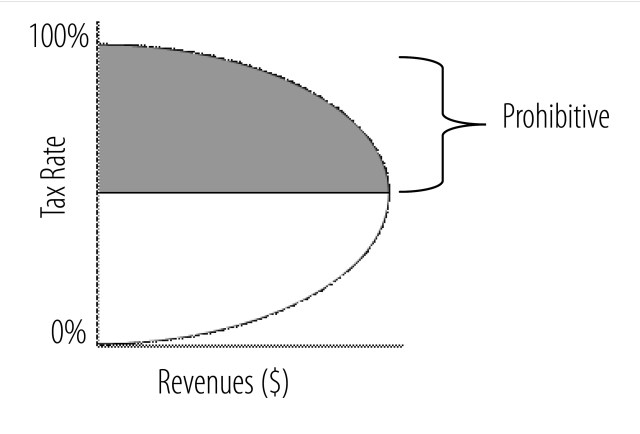
Dr. Arthur Laffer holds a PhD in economics and was the chief economist in President Nixon’s Office of Management and Budget from 1970 to 1972.  As the story goes, Laffer was having dinner with President Gerald Ford’s top advisors, Dick Cheney and Don Rumsfeld, in 1974 when the U.S. economy was in recession.  At the time the top income tax rate was 70 percent.  Laffer was counseling Cheney and Rumsfeld that the top federal tax rates were too high and that high taxes were stifling economic growth.  To emphasize his point, he drew a crude graph on a napkin that I believe looked something like graph from the Laffer Center depicted here.

LafferCurve-graphicLaffer’s purpose was to show that as the top tax rate goes up it initially increases revenue but at the tip of the curve economic growth is stifled and revenues begin to go down.  At a 100 percent tax rate no revenue would be collected because there would be no incentive to work.  This is obviously false since the top tax rate during 1952 and 1953 was 92 percent and lots of people were still working and paying taxes, even the very rich who were subject to that rate.

The key question was — and still is — at what top tax rate is revenue maximized without discouraging productivity and investment?  As far as I know Laffer did not suggest what the optimum tax rate would be at the time, although his symmetrical curve would seem to indicate that revenues would be maximized at a top tax rate of around 50%.  Today the top rate is 39.6 percent.

Devotees of the Laffer Curve use it to show that tax cuts stimulate economic growth and tax increases suppress economic growth.  The Laffer Curve has even been used to support a theory that tax cuts actually pay for themselves by creating strong economic growth.   In fact Treasury Secretary Steve Mnuchin claimed that Trump’s plan would do that.

In 1981 Dr. Laffer became a member of President Ronald Reagan’s Economic Policy Advisory Board and remained in that position for eight years.  It was during Reagan’s tenure that “supply-side economics” became the prevailing economic theory in the Reagan administration.  And Laffer was its champion.

No doubt Laffer influenced Reagan’s first big tax cut in 1981 that reduced the top rate from 70 percent to 50 percent. Then Reagan’s 1986 tax reform brought the top rate down to 28 percent in 1988.  This reform was designed to be revenue neutral so it collected the same amount of revenue as when the top tax rate was 50 percent.  Although rates came down significantly, this reform is not considered to have been a tax cut.

Dr. Laffer now runs Arduin, Laffer & Moore Econometrics (ALME), an organization that does consulting and studies for mostly Republican led states like Kansas and North Carolina.  Typically these studies suggest that if a state eliminates its personal and corporate income tax systems and replaces them with a much higher consumption (sales) tax, the state’s economy will boom.  Of course, a sales tax puts the greatest burden on middle to lower income wage earners and the elderly on fixed incomes.

The study that ALME did for North Carolina in 2012 was entitled, “More Jobs, Bigger Paychecks,” It recommended a consumption tax based system.  In January 2013 the Institute on Taxation and Economic Policy published a report that concluded the ALME study for North Carolina “relies on an economic analysis that is fundamentally flawed to the point of making it entirely useless.”

Kansas Republican Governor Sam Brownback relied heavily on Dr. Laffer’s advice when he and the Republican controlled legislature passed a massive tax cut in 2012.  But instead of stimulating strong growth, tax revenues plummeted and huge spending cuts became necessary.  To this day the Kansas economy has not kept pace with its neighboring states.  In short, the Kansas tax cuts were a disaster.

Here are a couple of other data points on tax cuts:  President John Kennedy reduced the top tax rate from 90 percent down to 70 percent (enacted in 1964 after his death).  This tax cut was by some measurements larger than Reagan’s 1981 cut but Kennedy is rarely mentioned as a tax cutter, nor is his tax cut touted as having spurred economic growth.

President George W. Bush engineered large tax cuts in 2001 and 2003 that were also larger than Reagan’s in some respects.  But his eight years in office ended in the Great Recession and he had the worst job creation record, on record, according to the Wall Street Journal.

There is nothing simple about tax policy, either in theory or in practice.  But in my opinion the Laffer curve is entirely too simplistic to be useful.  It focuses on the top tax rate when in truth the top rate is just one factor in tax policy as Reagan’s 1986 tax reform demonstrates.  So I would not conclude that the Laffer curve is a joke; I just don’t think it has much relevance in today’s economy and Republicans shouldn’t claim that it does.


Posted in Uncategorized | 7 Comments

Finally Voters Are Taking Notice

During the past eight years Republicans in Congress spent most of their time obstructing President Barack Obama’s agenda.   But they also focused on passing legislation that was popular with their base.  They tried to repeal Obamacare over 50 times.  They tried to defund Planned Parenthood and they did everything they could to eliminate or hobble climate change initiatives. The draconian concurrent budget resolutions they passed would roll back the social safety net and weaken the federal government.  And they promoted religious freedom laws that would protect individuals and businesses that use their religious beliefs as an excuse to discriminate.

Most of these bills simply slipped under the radar because everyone knew they would never be signed into law.  Republicans were overjoyed when they finally put a bill to repeal most of Obamacare on the Obama’s desk in 2015 but those who voted for it knew he would veto it.  Well, that very same bill failed miserably last week in the Senate as Majority Leader Mitch McConnell (R-Ky.) tried to pass something – anything — to weaken Obamacare.  His caucus wasn’t so enthusiastic when they knew their votes would have consequences.

The GOP quest to repeal Obama’s signature law is not over but the effort so far this year was stopped in its tracks due mainly to protests by concerned, involved citizens.  The Congressional Budget Office told them what Republicans were doing to their health care and they reacted loudly and forcefully.

Now Republican leaders are working on their second big priority, tax reform.   A robust infrastructure plan that would truly help boost the economy and aid American workers has fallen by the wayside.  Although a tax bill is thought to be an easier lift than health care, I am betting the public will be much more interested in the details of this legislation after the Obamacare repeal debacle.

Congress has abandoned Washington for a totally undeserved August vacation where they will no doubt get an ear full from constituents on their legislative failures during the past six months.  As they were departing President Trump was turning the White House into a carnival sideshow where no one seems to know what is going to happen next.  We can only pray that no crisis like 9/11 or hurricane Katrina occurs. 

Fortunately the news media has kept focused on the various investigations into Russian meddling in the 2016 election and I think most of the public is interested in this process too.  Trump didn’t help his cause by holding a two plus hour love-in with Russian President Vladimir Putin at the recent G-20 economic summit.  To me this meeting was an embarrassment to our nation and we have to wonder what Trump sees in the autocratic Putin who controls the media and eliminates his opponents.

Compared to most other members of the G-20 Russia is big “nothing burger.”  According to a chart published by the International Monetary Fund, Russia’s 2017 gross domestic product (GDP) will be $1.56 trillion.  That’s slightly less than Canada, slightly more than South Korea and only 63 percent of California’s GDP, the sixed largest in the world.  If not for the fact that Russia has around 4,000 nuclear missiles, most of which are probably aimed at the United States, the country would be of little significance in world affairs.  Putin wants to change that perception in any way he can.

So what does Russia have that makes it so important in Trump’s eyes.  Well, evidence indicates that Russian hackers helped him get elected.  No doubt he liked that.  Trump Jr. has disclosed that Russians are heavily invested in financing Trump’s businesses.  It’s hard to argue with that basis for friendship.  Or maybe, just maybe, Russia has some damning video or documents that could severely damage Trump. 

Some reporters are beginning to speculate that Putin was more interested in destabilizing our democratic processes than electing Trump.  Either way, he got so much more.   Trump is disrupting U.S. foreign policy and weakening American leadership around the world.  It seems obvious to me that Putin left tracks leading back to the Kremlin so the world would know that Russia could cyberattack the U.S. at will.  He thinks that makes Russia look like American’s equal.  But not even a savvy politician like Putin could have anticipated the chaos that is occurring in the Trump White House.

I try to look for a silver lining in Trump’s election and I’ll admit it is elusive.  But now Republican policies will finally be subjected to full public scrutiny like they were with the Obamacare repeal.  Then voters may come to understand what Republicans are trying to do to them.  Perhaps they will realize that these conservatives don’t really care about ordinary people’s health care or financial wellbeing.  And it may become clear to the middleclass that the GOP tax reform is nothing more than a gift to the rich at their expense.

Some may call me naïve and maybe I am.  But I relied on the fairness of well-informed juries in huge litigation cases during my career without regret.  I have to believe that when Trump and the GOP leadership show a callous disregard for the public wellbeing in legislation — as they did last week — the good people of this great country will rise up and reject it.  We shall see.

Footnote:  For those who read my blog about a letter to a Republican congressman; he has not responded.


Posted in Uncategorized | 1 Comment

House Budget Is Same Old, Same Old

House Budget Committee Chairman Diane Black (R-Ten.) rolled out the GOP’s fiscal year 2018 budget resolution last week entitled “Building a Better America (BBA).”  This budget covers fiscal years 2018 through 2027 and claims to achieve $6.5 trillion in total deficit reductions compared to the Congressional Budget Office spending and revenue baseline for the same period.  

Needless to say, that is a lot of money and these deficit reductions have to come from somewhere.  Either revenues must be increased or spending must be decreased or some combination of the two must occur.  Ms. Black claims that the BBA will produce a balanced budget with a $9 billion surplus in 2027.  That’s a pretty tall order since the CBO baseline projects a $1.4 trillion deficit for that year. 

So how will the BBA accomplish this magic?  As usual Republicans mostly want to cut social welfare programs and taxes.  The bullet points are quotes from their documents:

  • This budget addresses Obamacare by incorporating the House-passed American Health Care Act and all of its savings.

Oh, it assumes the AHCA will become law.  This bill barely passed in the House and it was roundly rejected by Senate Republicans.  Even the milder Senate Obamacare replacement legislation may fail.  Clearly the savings anticipated here are questionable.

  • Reforms Medicaid to ensure the program works best for the most vulnerable and gives states more power to tailor their Medicaid programs to meet the unique needs of their populations.

The Republican’s AHCA would reduce Medicaid funding by $800 billion over the next decade.   Perhaps they should have added:  “Prevents the need for painful medical procedures by eliminating your health care insurance.”  Congressional Republicans can’t sell the Medicaid proposals to their own members let alone the voters.

  • Saves and strengthens Medicare by moving to a premium support system that gives seniors more control of their health care. 

Yep!  This budget transitions Medicare to a system that provides beneficiaries a voucher with which to buy health care policies from insurance companies.  Supposedly there will be an “option” to retain traditional Medicare, but I suspect it will be too expensive for most seniors to afford.  When the public focuses on this proposal, all hell will break loose.

  • Border wall funding is also included in this budget through various Department of Homeland Security construction accounts.

Although this funding is not certain to survive amendments, did anyone doubt Republicans would try to fund the border wall even though it is widely believed to be a waste of money? 

  • This budget gives reconciliation instructions to 11 House committees to achieve at least $203 billion in mandatory savings and reforms (over 10 years). 

Here they are mainly talking about food stamps, housing assistance and other so-called entitlements.  Reductions to these programs will be difficult to achieve, but the House Freedom Caucus wants to cut double this amount. 

  • The resolution also instructs the Ways & Means Committee to produce deficit-neutral (revenue-neutral) tax reform legislation that will reduce tax rates and simplify the tax code to boost economic growth. 

What Republicans are actually talking about is a tax cut for the wealthy, which they always claim will jump start economic growth and create jobs.  But it doesn’t actually work that way.  President George W. Bush cut taxes significantly in 2001 and 2003 and he ended his eight years in office with the Great Recession and the worst job creation record, on record, according to the Wall Street Journal. 

But never mind the facts.  Tax reform is the real purpose of the BBA budget resolution.   It’s the vehicle by which tax legislation can be passed without fear of a Democratic filibuster in the Senate.  Unfortunately for the GOP leadership, this legislation faces tough sledding in the House.  The Freedom Caucus has already signaled that their support requires significantly more spending cuts and funding for the border wall.  They prevented passage of the GOP’s FY 2017 budget resolution in 2016.

  • We estimate that the pro-growth policies of health care reform, tax reform, welfare reform, and deficit reduction assumed in our budget will yield economic growth of 2.6 percent on average over the 10-year budget window, resulting in $1.5 trillion in deficit reduction.

Many economists would say that the BBA depends on a “pie in the sky” growth estimate.  The CBO believes economic growth will be much more modest over the next decade.  Just look at 2017.  Unemployment is low, corporations are quite profitable and still economic growth is less than two percent.

Don’t get me wrong; we need to reduce deficits and control the national debt.  But it must be done by controlling spending AND increasing revenues.  I am confident that Social Security, Medicare and Medicaid costs, which are by far the largest parts of the federal budget, can be much better controlled.  And I believe revenue can be increased while lowering the top tax rates, eliminating deductions and simplifying the tax code.  Both will require focused, bipartisan legislation.

Bipartisan, however, hasn’t been in the GOP lexicon for the past eight years. It’s the same problem they had with health care reform; major legislation must be passed with only Republican votes.  But even radical bills like the AHCA and the BBA fail to meet the far-right standards of Tea Party conservatives.  They haven’t changed since 2010 and neither have the budgets produced by Republicans since they took control of the House in 2011.


Posted in Uncategorized | Leave a comment

Get Ready For The BCRA Vote

Eight years ago newly elected President Barack Obama initiated a complex process to make a paradigm shift in the U.S. health care system.  The objective was to provide health insurance for more people.  In other words Democrats wanted to solve a health care problem.

After numerous hearings, debates and amendments Congress passed the Affordable Care Act known as Obamacare and it was signed into law in 2010.  Not one Republican voted for it.  This was probably due to Senate Minority Leader Mitch McConnell (R-Ky,) who didn’t want to give Democrats any chance to call this legislation bipartisan.

The narrative that Republicans spread was that the law was “crammed down our throats.”  They claimed that the GOP was shut out of the process and had no opportunity to participate in crafting the law’s provisions.  They also characterized Obamacare as a government takeover of health care.  All of this was mostly false but with the help of the right-wing media and wealthy conservative backers, their misinformation prevailed.

The whole idea of insurance is spreading the risk over large populations.  This is true for homeowners insurance, auto insurance and so on.  For example, I have never filed a claim on my homeowners insurance in over 40 years yet my premiums have paid for a lot of claims by others.  The same is basically true for my auto insurance, which I am required to maintain by state law.

I have always thought of Obamacare as a health insurance regulation rather than a government program like Medicare.  But the law is so complicated that very few pundits or politicians have a clear understanding of how it works and neither do those who benefit from it.

One of the simplest and best explanations of Obamacare was provided by Paul Krugman in a recent New York Times article entitled “Three Legs Good, No Legs Bad.”  In this article Krugman explained that Obamacare is like a stool with the following three legs:

1.      Insurers must offer the same plans to everyone at the same prices, even those with pre-existing conditions.

2.      Everyone is required to have health insurance or pay a penalty (the individual mandate) and all policies must cover 10 essential health benefits, including hospitalization.

3.      Government provides subsidies to help those with lower incomes purchase plans and those with really low incomes are provided insurance through an expanded Medicaid program mostly funded by the federal government.

Leg one spreads the cost of medical care across those who are healthy and those with pre-existing conditions, which adds stability to the insurance markets.  Let’s face it, insurers don’t care if everyone has health insurance, their main objective is making a profit.  They need more healthy people paying premiums to offset the cost of medical expenses for those who aren’t healthy in order to do that.  For them it is just that simple.

Leg two is designed to make sure more healthy people buy health care policies and that those policies are not skimpy plans that really aren’t much better than no insurance at all.  Leg three provides resources so that those with lower incomes can afford to buy plans and insures that those who could not afford plans even with subsidies will have health insurance.

Needless to say, if one leg of a three legged stool is removed it will collapse.  The same is true of the Obamacare legs.   Conservative Republicans understood this so they attempted to remove these legs via strategic legal attacks.  Their most serious challenge was to the individual mandate that required everyone to have health insurance.  It narrowly failed in the Supreme Court.

Today, after seven years of failed attempts to defeat Obamacare, conservatives are about down to the last chance they will have this year to get the job done.  Their vehicle is the Senate’s Better Care Reconciliation Act (BCRA).

Although this bill will not fully repeal Obama’s law, it will do serious damage to it.  Opponents who have a flair for the dramatic might say that those with pre-existing conditions, many older adults and the poor are standing on Obamacare’s three legged stool with a noose around their necks.  These detractors believe that the BCRA will kick the stool out from under them.

Their fears are probably well founded.  The BCRA includes an amendment by Sen Ted Cruz (R-Texas) that would allow insurers to offer bare-bones policies so long as they offer one Obamacare qualifying plan.  This would eliminate leg one and the part of leg two that requires plans to cover essential benefits.  Other parts of this Act repeal the individual mandate of leg two, lower the subsidies of leg three and cut $772 billion over 10 years from its Medicaid funding.

We must wait for the Congressional Budget Office score next week to more fully assess the damage the BCRA will cause to the U.S. health care system but I think it will be extensive.

Congressional Republicans promised to have Obamacare repealed and replaced within weeks after Trump was inaugurated.  Yet the process has dragged on for almost six months.  There are good reasons for the difficulties.  Republicans are not trying to solve a health care problem; far from it.  They are trying to solve a political problem with their supporters and eliminate the Medicaid program as it currently exists.

I think this tells us all we need to know about the BCRA.

Posted in Uncategorized | 3 Comments

A Letter to a Republican Congressman

Ten years ago while vacationing with the family I met a freshman Republican congressman whose family was on the same tour.  Since we belonged to the same party and had a mutual friend in the U.S. House we connected.  Almost immediately I liked this young guy.  He was down to earth, level headed and thoughtful.

Over the years I followed his career and the positions he was taking in Congress.  While we haven’t agreed on many policies, my positive opinion has never changed regarding his character, his dedication to his constituents and his love of country.

Recently I decided to express my concern about the administration of President Donald Trump in a letter to my vacation friend.  This is the substance of that letter:

____________

Over the years I have watched the GOP move further and further to the right.  Fox News, dozens of right-wing radio talk-show hosts, the National Rifle Association and funding from conservative and libertarian billionaires like the Koch brothers have been pushing the Party toward a no compromise mindset that I think threatens our Republic and our democratic processes. These conservatives have fomented hatred of all those who do not agree with them.

The media, those who protest and “the Left” are demonized as dangerous or unfit to govern.  The logical conclusion is that those on the left should not be allowed in government.  A recent NRA video appeared to be a call for violence against progressives.  The NRA represents hundreds of well-armed militia groups that are eager to comply.

The election of Donald Trump has exacerbated the dangers.  I strongly believe that Steve Bannon, Stephen Miller and other members of the Trump administration, along with some factions within the Party, now believe it is their mission and duty to decimate the federal administration and take complete control of the government.  If they can fill the federal benches and the Supreme Court with enough like-minded jurists they just might be able to do it.

These coming months could make all the difference for the future of the United States.  If the investigations of Russia’s involvement in the 2016 election and related activities by the Trump campaign and Trump’s associates are terminated without full disclosure and without prosecution of guilty parties I believe our nation will be severely and permanently damaged.

It is my fervent hope that you will help prevent these calamities.

____________

This letter might seem too pessimistic for some folks and some might scoff at the suggestion that an American political party would seek to totally eliminate its opposition.  They may counter by highlighting the separation of powers in the Constitution and claim that the Supreme Court would never allow that to happen.   I hope they are right.  But just consider what Republicans have been doing in state legislatures, in the Congress and now in Trump’s administration.

In 2010 Republicans took control of many state houses and elected GOP governors.  In 2013 many of these states enacted strict voter ID laws after the conservative majority on the Supreme Court struck down Section 4 of the Voting Rights Act.  Federal courts have held that several of these laws were designed to make voting more difficult for minorities and others who typically vote for Democrats.  Some of these states also conducted purges of the voter rolls that resulted in the elimination of properly registered voters, particularly minorities.

In Congress Minority Leader Mitch McConnell (R-Ky.) embarked on a policy of total obstruction of President Obama’s agenda in 2009.  His efforts resulted in over 100 vacancies on federal courts at the end of Obama’s second term and a vacancy on the Supreme Court.  It was as if McConnell believes that only Republicans should be allowed to appoint federal judges.

Of course, Trump and Senate Republicans quickly filled the Supreme Court vacancy with a very conservative jurist, Neil Gorsuch.  Over time Trump may be able to appoint two or more additional Supreme Court justices and up to 38 percent of the federal judiciary according to one study.  No doubt he will politicize the courts with judges that will support his agenda.

Recently Trump appointed Kansas Secretary of State Kris Kobach as head of a newly created Election Integrity Commission.  The commission is supposedly investigating illegal voting in the 2016 election.  Trump believes voter fraud cost him the popular vote even though he has no credible evidence to prove that.  Regardless, Kobach has requested that all 50 states provide the commission with private information from their voter rolls, including how people voted back to 2006.  Kobach is a well-known champion of voter suppression and I believe he will use this information for that purpose.

Trump’s attacks on the media are continuous, unprecedented and vicious.  He even called the media the enemy of the people.  This week he lauded Poland where the press is controlled by the government and he said it was an “honor” to meet Russian President Vladimir Putin who likely ordered a cyberattack on our 2016 election and who also controls the media.

Trump seems to have no appreciation for the rule of law and he talks like a would-be dictator who would eliminate freedom of the press if he could.

Yes, some may read my letter and ask why I’m so concerned for our Republic and its democratic processes.  My answer is:  All of the above and a lot more.

Posted in Uncategorized | 8 Comments

Will the GOP Tax Reform Fail Too?

Speaker of the House Paul Ryan (R-Wis.) is desperate to pass tax reform legislation.  His objective is to replace President Ronald Reagan’s 1986 tax reform with a “revenue neutral” plan that would not alter the current Congressional Budget Office 10 year revenue projection of $43 trillion.

There are several reasons why Ryan is taking the reform route.  Under the 1974 budget act, legislation that increases deficits after 10 years must expire in 10 years.  This law caused President George W. Bush’s budget busting tax cuts of 2001 and 2003 to end on December 31, 2012.  (Remember the fiscal cliff?)  Tax legislation that is revenue neutral becomes permanent and is much more difficult for a future administration to change.

Ryan’s plan proposes a border adjustment tax of 20 percent to be levied on imports.  This tax would collect $1 trillion over 10 years.  Needless to say Walmart and numerous other retailers and importers are strongly opposed to it.  So why does Ryan want this unpopular tax increase?  Well, the added revenues will allow him to give greater tax cuts to the wealthy and still keep his tax plan revenue neutral.

The GOP’s Better Care Reconciliation Act (BCRA ) being argued in the Senate also figures in Ryan’s tax planning.  The BCRA repeals the Obamacare taxes, which would reduce federal revenues by around $1 trillion over 10 years.  Consequently Ryan’s plan could be revenue neutral by collecting $42 trillion instead of currently projected revenues of $43 trillion — and he could give even greater tax cuts to the wealthy.

Still, how do Republicans cut tax rates without decreasing revenues?  It’s really quite simple; they shift the tax burden to those who aren’t so wealthy and even to some who are.  Tax experts call it broadening the tax base.  One way to do this is by eliminating deductions and loop holes.  For example, the mortgage interest deduction is a huge benefit to millions of homeowners.  Placing limits on the amount of interest that can be deducted or limiting the deduction to one home would add billions to government coffers.

Another important itemized deduction is that for state and local taxes.  Ryan’s plan would eliminate it.   Of course, taxpayers in high income tax states like California, New York and other typically Democratic controlled states would likely suffer the most if they can’t take this deduction, particularly the wealthy.

Can tax reform be passed quickly by partisan politicians?  Not likely.  The effort on Reagan’s tax reform began in November 1984.  By the time it was signed in October 1986 it was a bipartisan bill supported by prominent Democrats.  Republicans liked it because it lowered the top rate to 28 percent.  Democrats liked it because it closed loop holes and raised the capital gains rate from 20 percent to 28 percent.  Even though Reagan lowered the top tax rate from 50 percent to 28 percent, taxes increased for some higher income taxpayers and for corporations.

That’s the way tax reform is done; it benefits some and burdens others.  Therefore it is difficult to achieve and takes a long time to accomplish.  For Reagan it took around two years.  Ryan and the GOP are trying to accomplish this feat in a couple of months and without support from Democrats.

President Trump has a tax proposal too.  It differs somewhat Ryan’s plan and it doesn’t attempt to achieve revenue neutrality by cutting some taxes and raising others.  According to Treasury Secretary Steve Mnuchin Trump’s plan will “pay for itself” with enhanced economic growth.  Ryan knows that won’t happen and so do many Republicans.  Just last month they watched the “pay for itself” tax cut plan of Tea Party Kansas Gov. Sam Brownback go down in flames after it caused four years of fiscal agony for Kansas.

The BCRA has apparently backed up everything in Congress and Republicans can’t seem to find the right laxative.  Lawmakers haven’t started to deal with raising the debt limit; and they haven’t produced the 12 appropriations bills for FY 2018 that starts October 1.  Congress is scheduled to recess the entire month of August, and as the song says, “the days grow short when you reach September.”

Perhaps Speaker Ryan and Senate Majority Leader Mitch McConnell will try to pass a health care bill and a debt limit increase in July.  They may also cancel the August recess so Republicans can work on tax legislation and the appropriation bills. Obviously they are running out of options.

I think the only thing Republicans can do with taxes this year is cut the rates for higher income taxpayers and fiddle with some other provisions of the 1986 law.  Lowering rates will no doubt increase the federal deficits that are already projected to add $9.5 trillion to the national debt by 2027 according to the CBO.

Still, there is a chance that none of this legislation will come to fruition by late September.  Then Congress will have to pass another “kick the can down the road” continuing resolution to temporarily fund the government and increase the debt limit.

The Republican legislative fiascos so far this year clearly show how an incompetent president and a divided GOP handle domestic issues – very poorly.


Posted in Uncategorized | Leave a comment