
The pressure for tax reform is building. Conservative organizations are spending millions on TV ads directed at the middleclass who likely won’t get much tax relief from the GOP plan. President Trump has promoted tax reform at two campaign-style rallies and numerous similar rallies are planned. CEOs of large corporations are claiming that reducing the 35 percent corporate tax rate is critical for economic growth even though many of them paid single digit federal tax rates last year.
There will be so many proposals flying around that I wanted to provide some information that might help readers understand how tax reform will go down and what it might mean for federal deficits.
First, what is the process to do tax reform? Republicans want to use budget reconciliation to pass tax legislation without Democratic votes. This requires that both chambers of the Republican-controlled Congress first approve a concurrent budget resolution for fiscal year 2018 that includes instructions for passing tax reform. But GOP House members can’t agree on the budget numbers so this critical step has not yet been taken.
What is tax reform? Well, it is a major overhaul of the existing tax code that includes fundamental changes to rates, deductions and credits for individuals and corporations. Republicans are also keen to eliminate the estate tax and the alternative minimum tax that apply mainly to the wealthy.
What is revenue-neutral tax reform and why is it necessary? Revenue-neutral means that the new law collects the same revenue as the existing law. Under the complex reconciliation rules, legislation that increases the deficits beyond the 10-year budget period must expire in 10 years. Theoretically revenue-neutral legislation doesn’t increase deficits so it becomes permanent. That is what GOP leaders want to achieve.
Why is revenue-neutral tax reform so difficult? Sen. Orin Hatch (R-Utah) explained it with just a few words: “Everything on the (tax) books has a constituency, and that’s one of the problems.”
True, it’s like robbing Peter to pay Paul. If taxes are lowered for one group of taxpayers they must be raised for some other group to maintain the same revenue stream. The trick is to increase taxes on those who would be least likely to have powerful supporters. Typically, Republicans do this by imposing some form of regressive excise taxes on middleclass and lower income folks.
What will tax reform or tax cuts mean for the federal deficits? In January the Congressional Budget Office published its baseline for federal revenues and spending through 2027. Under the law existing at the end of 2016 federal deficits were projected to reach $1 trillion in 2023 and keep increasing through 2027. The aging population is partially to blame.
Even with revenue-neutral tax reform deficits would still be horrific for the last half of the coming decade. Simply cutting the existing tax rates would exacerbate these deficits significantly unless huge reductions in federal spending are made.
What are some of the tax proposals Republicans have floated? Speaker Ryan wanted a regressive border adjustment tax on imports that would increase the cost of consumer goods and raise $1 trillion in revenues. That tax was shot down by conservative donor Koch Industries and retail heavyweights like Walmart.
Trump wants the top corporate rate lowered to 15 percent. Sen. John Thune (R-S.D.), the third ranking Senate Republican, estimated that getting the rate down from 35 to 20 percent as House Republicans proposed would cost about $100 billion per point. In other words, Thune believes reducing the corporate rate to 20 percent would cut revenues by $1.5 trillion over 10 years. I don’t think Trump’s 15 percent rate is even being considered.
Ryan had another proposal that would allow businesses to rapidly write off the full cost of capital expenditures in the year purchased. In theory that would encourage businesses to buy lots of equipment. The cost of these purchases could be deducted from taxable income, which would lower their taxes. That’s not a bad way to spur the economy and it has worked on a much more limited scale in the current tax code.
But powerful corporate interests like Koch believe this provision would shave $2 trillion from federal coffers over a decade so they oppose it. They want lower corporate rates that allow them to do what they want with the extra cash.
Ryan is now advocating the elimination the deduction for state and local taxes to offset the cost of lower tax rates. This would hurt residents of Democratic states like New York and California where taxes are high. One of the most popular and revenue costly deductions — home mortgage interest — may also be on the chopping block.
It is difficult to determine what the final Republican plan will be or if it will be signed into law this year. Goldman Sachs recently lowered its expectations of an economically meaningful tax package to 40 percent.
Like the effort to repeal and replace Obamacare, tax reform will probably boil down to Republicans battling Republicans. This time, however, they will likely get something done – even if it’s far less than their constituents want.
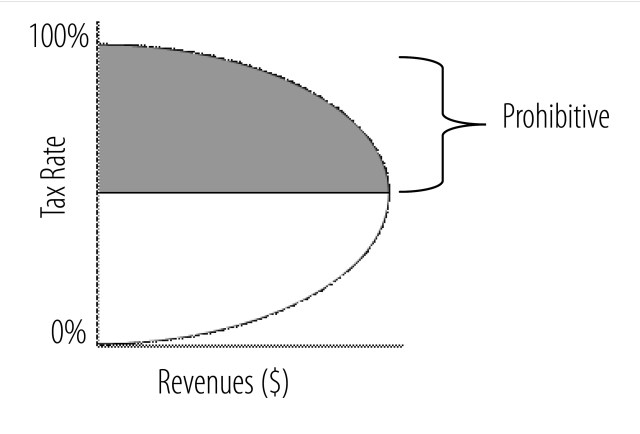 Laffer’s purpose was to show that as the top tax rate goes up it initially increases revenue but at the tip of the curve economic growth is stifled and revenues begin to go down. At a 100 percent tax rate no revenue would be collected because there would be no incentive to work. This is obviously false since the top tax rate during 1952 and 1953 was 92 percent and lots of people were still working and paying taxes, even the very rich who were subject to that rate.


